
All sales to the United States government and to the State of Colorado in their governmental capacities only are exempt from Colorado and state-collected local sales taxes. The exemption applies to all departments and institutions of the State of Colorado, as well as political subdivisions of the state, such as county and local governments, school districts, and special districts.. Additionally, the storage, use, consumption, or loan of tangible personal property by or to any of these governmental entities, in their governmental capacities only, is exempt from Colorado use tax. The exemption for governmental entities discussed in this publication also applies to county lodging taxes, visitor benefit taxes, and local marketing district taxes.
This publication is designed to provide general guidance regarding sales and use tax exemptions for governmental entities and to supplement guidance provided in the Colorado Sales Tax Guide. Nothing in this publication modifies or is intended to modify the requirements of Colorado’s statutes and regulations. Retailers and consumers are encouraged to consult their tax advisors for guidance regarding specific situations.
The information in this publication applies to Colorado and local sales taxes administered by the Department. The information in this publication does not apply to the sales taxes of any home-rule cities that the Department does not administer. Please contact any applicable home-rule city directly for information about their sales and use taxes. Contact information for home-rule cities can be found in Department publication Colorado Sale/Use Tax Rates (DR 1002).
Conditions for exemption
All four of the following conditions must be met for the sales tax exemption to apply:
- The purchase must be made by a qualifying governmental entity.
- The purchase must be made using a prescribed government form or purchase order.
- The purchase must be made by the government entity acting in its governmental capacity.
- The governmental entity must make the purchase directly by warrant or check drawn on govern-mental funds or with a government credit card.
Purchases made with government credit cards may qualify for exemption, but only if the credit card is billed directly to the governmental entity (a centrally billed account or “C B A”) and not to the individual card holder (an individually billed account or “I B A”). Additional information about specific types of state and federal credit cards may be found later in this publication.
If a purchase of tangible personal property qualifies for exemption from Colorado sales tax, the governmental entity’s storage, use, and consumption of the property is also exempt from Colorado use tax.
Purchases that do not qualify for exemption
Purchases that do not satisfy all of the preceding conditions do not qualify for exemption. The sales and use tax exemptions discussed in this publication do not apply to any purchase made by an independent contractor performing work for a governmental entity, regardless of whether the governmental entity reimburses the contractor for its expenses. Please see Department publications FYI Sales 6 and Sales & Use Tax Topics: Affordable Housing Projects for information about exemptions applicable to government construction projects.
Additionally, sales made by governmental entities generally are not exempt from Colorado sales tax. Please see the Colorado Sales Tax Guide for information about licensing, collection, filing, and remittance requirements for sales made by governmental entities.
Exemption certificates
Tax-exempt governmental entities may apply for a Colorado sales tax exemption certificate, but they are not required to do so. Application for an exemption certificate may be made with form DR 0715, Application for Exempt Entity Certificate. Each Colorado sales tax exemption certificate has a unique tax-exemption number, beginning with either “98” or “098”, that can be verified online at Colorado.gov/RevenueOnline.
U.S. government credit cards
Whether a purchase made with a U.S. government credit card is exempt from sales tax depends, in part, on whether the card account is a centrally billed account (“C B A”) or an individual billed account (“I B A”). Purchases made with a C B A may qualify for exemption, but purchases made with an I B A do not.
The various types of U.S. government credit cards can be recognized and identified by certain criteria, such as the appearance of the card and, in some cases, the sixth digit of the card number. Certain types of U.S. government credit cards are always billed to a C B A, while others may be billed to an I B A with respect to some or all purchases made with the card. Additional information about the U.S. government’s GSA SmartPay Program can be found online at SmartPay.GSA.gov, SmartPay.GSA.gov/merchants/vendor-guide, and SmartPay.GSA.gov/smarttax/recognizing-your-account.
Centrally billed accounts (C B A)
Three types of U.S. government (GSA SmartPay) credit cards are always billed to a C B A: purchase accounts, fleet accounts, and integrated accounts.
GSA SmartPay purchase accounts
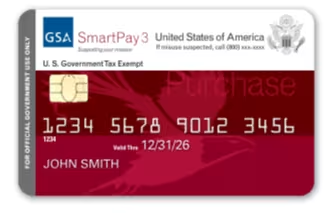
The GSA SmartPay purchase account is a procurement and/or payment mechanism designed for the federal government to make purchases for required goods and services and payments against government contracts. Credit cards for GSA SmartPay purchase accounts are the color red and say both “Purchase” (in red lettering) and “U.S. Government Tax Exempt” on the front.
GSA SmartPay fleet accounts
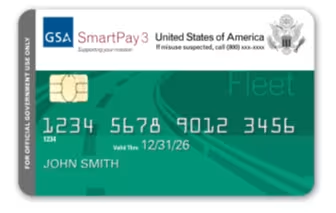
The GSA SmartPay fleet account is specifically designed for the purchase of fuel, maintenance services, and repair services of official government vehicles. Credit cards for GSA SmartPay fleet accounts are the color green and say “Fleet” (in green lettering) on the front.
GSA SmartPay integrated accounts
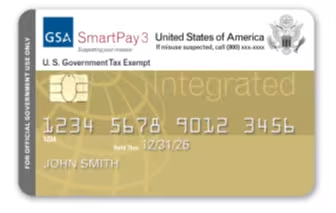
The GSA SmartPay integrated account is a specialized account designed to combine the functions of the purchase, travel, and fleet business lines into one payment solution. Credit cards for GSA SmartPay integrated accounts are the color gold and say “Integrated” (in gold lettering) and “U.S. Government Tax Exempt” on the front.
GSA SmartPay travel accounts
There are three types of GSA SmartPay travel accounts: C B A, I B A, and a C B A-I B A combination called a Tax Advantage Travel account. The type of account can be determined by the color of the card and the sixth digit of the card number.
GSA SmartPay Tax Advantage travel accounts
The GSA SmartPay Tax Advantage travel account is a combination of C B A and I B A, depending on the type of purchase. Charges for rental cars and lodging are automatically billed to a C B A for payment. Charges for other travel-related purchases, such as meals and incidentals, are billed to the I B A portion of the account.
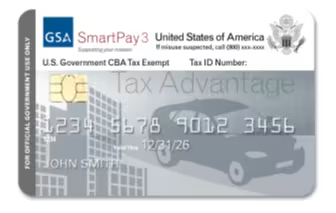
Credit cards for GSA SmartPay purchase accounts are silver in color and say both “Tax Advantage” (in silver lettering) and “U.S. Government C B A Tax Exempt” on the front.
Other GSA SmartPay travel accounts
Other GSA SmartPay travel accounts may be either C B A or I B A. The type of account is determined by the sixth digit in the credit card number:
| Sixth digit | Account type |
|---|---|
| 1, 2, 3, or 4 | I B A |
| 6, 7, 8, 9, or 0 | C B A |
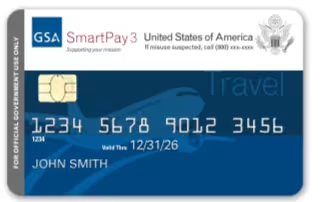
Credit cards for GSA SmartPay travel accounts are blue in color and say “Travel” (in blue lettering) on the front.
Colorado government credit cards
Colorado’s Commercial Card Program provides government credit cards to:
- state agencies;
- legislative and judicial branches;
- state institutions of higher education;
- community colleges;
- local governments (counties, school boards and districts, municipalities, or other public agencies or authorities); and
- other governmental entities.
Whether a purchase made with a Colorado government credit card is exempt from sales tax depends, in part, on whether the card account is a centrally billed account (C B A) or an individual billed account (I B A). Purchases made with a C B A may qualify for exemption, but purchases made with an I B A do not.
The various types of Colorado government credit cards, issued by U.S. Bank, can be recognized and identified by the words and tax exempt number appearing on the fact of the card. Generally, Colorado government credit cards are billed to a C B A, with one exception. Some Colorado travel cards are billed to an I B A. Additional information about Colorado’s Commercial Card Program can be found online at osc.colorado.gov/financial-operations/ccard.
Centrally billed accounts (C B A)
Two types of Colorado government credit cards are always billed to a C B A: purchasing cards and One Cards.
Purchasing cards
Purchasing cards are used for small purchases (under $10,000) of general merchandise and services. Purchasing cards have on the front the State of Colorado’s tax-exempt number 98-02565, the words “FOR APPROVED BUSINESS ONLY”, and the word “PURCHASING”.
One Cards
The One Card is an integrated card and a combination of a purchasing card and a travel card. One Cards have on the front the State of Colorado’s tax-exempt number 98 02565, the words “FOR APPROVED BUSINESS ONLY”, and the word “COMMERCIAL” or “ONE CARD”.
Colorado government travel cards
There are two types of Colorado government travel cards: one that is billed directly to the governmental entity (a centrally billed account or “C B A”) and one that is billed to the individual card holder (an individually billed account or “I B A”). Travel purchases made with a C B A card may qualify for exemption, but purchases made with an I B A card may not.
Centrally billed (C B A) travel cards
Centrally billed (C B A) travel cards have on the front the State of Colorado’s tax-exempt number 98-02565 and the words “FOR BUSINESS TRAVEL ONLY”. Travel purchases made with centrally billed travel cards may be exempt from sales tax, if the other conditions for exemption described earlier in this publication are met.
Individually billed (I B A) travel cards
Individually billed (I B A) travel cards have on the front the words “FOR INDIVIDUAL BUSINESS TRAVEL ONLY”. Travel purchases made with individually billed travel cards are not exempt from sales taxes.
Local government credit cards
Purchases made with credit cards used by political subdivisions in Colorado such as county and local governments, school districts, and special districts are exempt from state and state-administered local sales taxes if the card is centrally billed (C B A) and all of the conditions for exemption described earlier in this publication are met. Local governments may participate in the State Commercial Card Program and use the credit cards for that program described earlier in this publication.
Purchases made with individually billed (I B A) credit cards or by political subdivisions and local governments of any state other than Colorado are not exempt from Colorado state and state-administered local sales taxes.
Diplomatic sales tax exemption cards
The U.S. Office of Foreign Missions (OFM) issues diplomatic tax exemption cards to eligible foreign missions and their accredited members and dependents on the basis of international law and reciprocity. The cards provide point-of-sale exemption from sales tax and other similarly imposed taxes throughout the United States. Please visit the OFM’s website at state.gov/sales-tax-exemption for additional information regarding diplomatic tax exemption cards.
Retailer responsibilities
A retailer must exercise due diligence with respect to any sale for which the purchaser claims exemption from sales tax. If evidence readily discernible to the retailer at the time of the sale provides reason to doubt the purchaser’s eligibility for the exemption claimed, the retailer must either obtain and retain sufficient information and documentation from the purchaser to resolve the doubt or must collect the applicable tax.
Sellers must consider whether goods or services sold to a governmental entity would be reasonably used in a governmental capacity. Sellers must also verify that:
- the purchase is made using a prescribed government form or purchase order; and
- the purchase is made directly with governmental funds or a government credit card.
Tax-exempt governmental entities which have obtained a Colorado sales tax exemption certificate may provide it or the tax-exemption number from it to a retailer at the time of the sale, but an exemption certificate is not required for tax-exempt purchases by governmental entities. If a governmental entity does provide an exemption certificate or exemption number, the retailer can verify the certificate and exemption number online at Colorado.gov/RevenueOnline. Form DR 5002, Declaration of Wholesale or Entity Sales Tax Exemption, may also be completed for a tax-exempt purchase by a governmental entity but is not required.
Retailers bear the burden of proof for the proper exemption of any sale upon which the retailer did not collect sales tax. If the retailer is unable to verify the purchaser’s eligibility for exemption from sales tax, the retailer must collect the applicable tax at the time of the sale and issue the purchaser a receipt showing the names of the retailer and purchaser, the item(s) purchased, the date, price, amount of tax paid, and a brief statement of the claim of exemption. The purchaser may request a refund from the Department of the tax paid using the applicable Department form.
Additional resources
The following is a list of statutes, regulations, forms, and guidance pertaining to sales and use tax exemptions for governmental entities. This list is not, and is not intended to be, an exhaustive list of authorities that govern the tax treatment of every situation. Individuals and businesses with specific questions should consult their tax advisors.
Statutes and regulations
- § 39-26-704, C.R.S. Miscellaneous sales tax exemptions – governmental entities.
- § 39-26-713, C.R.S. Tangible personal property
- Rule 39-26-704-1.
- Rule 39-26-105-3. Documenting exempt sales.
Forms and guidance
- Tax.Colorado.gov
- Colorado.gov/RevenueOnline
- Colorado Sales Tax Guide
- Colorado Sale/Use Tax Rates (DR 1002)
- Form DR 0715, Application for Exempt Entity Certificate
- Form DR 5002, Declaration of Wholesale or Entity Sales Tax Exemption
- Sales & Use Tax Topics: Affordable Housing Projects
- smartpay.gsa.gov
- SmartPay.GSA.gov/merchants/vendor-guide
- SmartPay.GSA.gov/smarttax/recognizing-your-account
- osc.colorado.gov/financial-operations/ccard
- state.gov/sales-tax-exemption